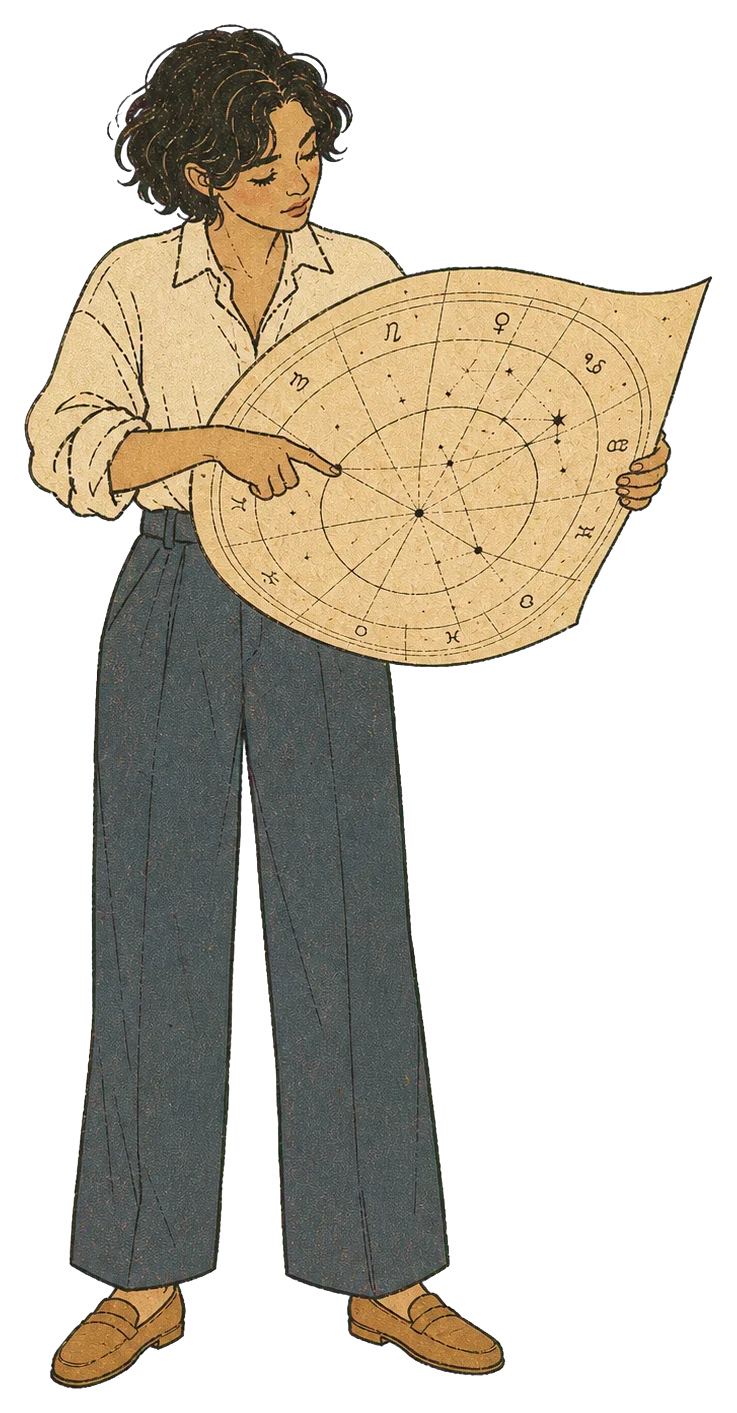
What a chart needs
A chart calculation uses a date, exact local time, and birthplace. The location establishes the horizon; the time establishes which sign was rising and where each house begins. Without a reliable time, planet signs may still be usable, but the Ascendant and houses may be wrong.
The “big three”
The Sun describes the developing center of identity. The Moon describes emotional needs and automatic responses. The Ascendant, or rising sign, describes the eastern horizon at birth and sets the structure of the houses.
They are a useful entry point, not a summary of the whole person.
A practical reading order
- Confirm the birth data and house system.
- Find the Ascendant and its ruling planet, called the chart ruler.
- Read the Sun and Moon by sign, house, and major aspects.
- Look for repeated themes: dominant elements, crowded houses, and tight aspects.
- Only then interpret individual placements in detail.
Common beginner mistakes
A chart is not a collection of isolated labels. Avoid treating one placement as destiny, counting every aspect equally, or assuming a difficult-looking configuration guarantees a bad outcome. Tight, repeated patterns tend to matter more than a long list of weak ones.
NEXT GUIDEMeet the planets →